
Septic Tank Installation
If your home isn't connected to the mains sewer, everything that leaves your sinks, showers and toilets depends on a private drainage system working quietly in the ground outside. Getting it right means weighing up your soil, the space you have and environmental rules that have become much stricter in recent years. That's why it pays to plan it properly from the start.
At Plumbco, we design and install septic tanks, sewage treatment plants and cesspits for homes throughout Dorset, Hampshire and Wiltshire. Each system is sized around the number of people living in your property and designed to meet the Environment Agency's General Binding Rules and Building Regulations. We never charge any callout fees, or extra for evenings, weekends or holidays, so the fixed price we agree before work starts is the price you pay.
To find out more, give us a call now or get in touch by using the link below.
Off-Mains Drainage Systems We Install
Not every property suits the same system, because the right choice depends on your ground conditions, the space available and where the treated water can safely go.
Here are the options our engineers install:
Septic Tanks
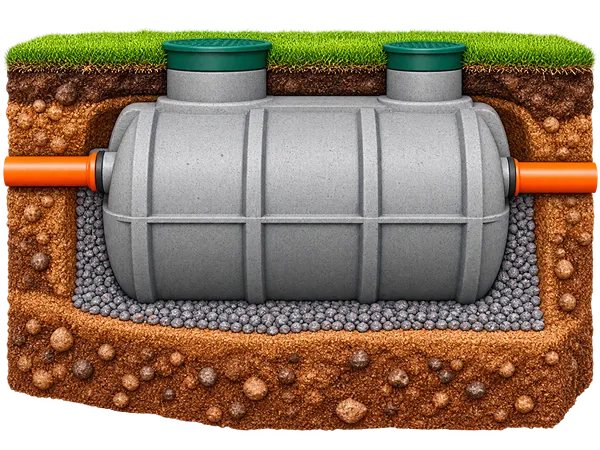
A septic tank is a buried chamber that holds the wastewater from your home long enough for the solids to separate out. The heavier material sinks to the bottom, where natural bacteria slowly break it down. The partly treated liquid then flows out into a drainage field and finishes its treatment as it filters through the soil. Because the ground does part of the work, a septic tank suits properties with free-draining soil and enough room for a drainage field that meets the rules.
Those rules changed in January 2020. A septic tank in England can no longer discharge straight into a stream, ditch or river. If yours does, it will need either a new drainage field or replacing with a sewage treatment plant. We'll look at your current setup and explain which route is the more cost-effective for your property.
Sewage Treatment Plants
Where a septic tank relies on the soil to finish the job, a sewage treatment plant, sometimes called a package treatment plant, does far more of the cleaning inside the unit itself. It pumps air through the wastewater so that bacteria can break it down much more thoroughly. As a result, the water that comes out is clean enough to go into a watercourse under the General Binding Rules, with no drainage field needed.
This makes a treatment plant the sensible choice when the ground doesn't drain well, the water table is high, space is tight or a drainage field simply isn't possible. We install treatment plants from established manufacturers and will help you choose a unit that suits your household.
Cesspits and Cesspools
A cesspit, also known as a cesspool, is a sealed tank with no outlet at all, so everything that goes into it stays there until a licensed tanker comes to empty it. Because that needs to happen often, the running costs add up quickly. This is why we see a cesspit as a last option for sites where neither a septic tank nor a treatment plant will work. When it is the only practical answer, we install it to the required standards, but we'll always talk you through the alternatives first.
Drainage Fields and Soakaways
Most septic tanks need a drainage field, also known as a soakaway or infiltration system, to spread the treated water through the ground. Before we design one, we carry out a percolation test to find out how quickly your soil absorbs water. We then lay out the drainage field to BS 6297 and install the complete system with inspection points, so it can be checked and maintained easily in the years ahead.
Regulations and Compliance
Choosing the right system is only part of the picture, because every off-mains installation also has to satisfy several sets of rules. In England, these include the Environment Agency's General Binding Rules, Building Regulations Approved Document H and the Environmental Permitting Regulations. We design each installation with all of them in mind:
- General Binding Rules: Introduced in 2015, these set out when a septic tank or treatment plant can run without a bespoke permit from the Environment Agency. They cover daily discharge limits, how far the system must sit from watercourses and water supplies, and how it should be sized for the property. They also include the ban on septic tanks discharging to surface water, which took effect in January 2020.
- Building Regulations Part H: Every new off-mains system must meet Building Regulations requirements for tank size, drainage field design, depth, access and ventilation.
- BS 6297: This is the British Standard that covers how drainage fields serving septic tanks should be designed and installed.
- Environmental Permits: If your system falls outside the General Binding Rules, perhaps because the discharge is too high or the site is in a sensitive area, you'll need a bespoke permit. We can manage that application for you.
Call or send an enquiry.
Our Installation Process
With the rules covered, this is how an installation comes together, from our first visit to the day we hand the system over to you.
Site Survey and Percolation Testing
System Design
Compliance Checks
Excavation and Tank Installation
Drainage Field Construction
Testing and Handover
Why Choose Plumbco?
Septic Tank Installation FAQs
The cost depends on which system suits your property, the size of tank your household needs, your ground conditions and how easy the site is to reach. A treatment plant usually costs more than a septic tank, although it can remove the need for a drainage field, which sometimes narrows the gap. Once we've carried out the site survey and percolation test, we'll give you a fixed price, so you know exactly what you'll pay before anything starts.
Talk to Us About Your Septic Tank Installation
Whether you're building off the mains, replacing an older tank or simply unsure what your property needs, our team can talk you through the options in plain terms. A real engineer answers our phone in under 60 seconds. Call us on 0808 303 8888 or fill in our contact form, and we'll arrange a site survey at a time that suits you.
-
Engineers on call 24/7
-
A clear price before we start