
Expert Tree Root Removal
Tree roots are one of the most common causes of blocked and damaged drains anywhere in the country, and a pipe rarely needs much encouragement before they find a way in. A tiny crack, a shifted joint or a worn seal is enough to let moisture escape into the surrounding soil, and that moisture is exactly what a searching root is drawn towards. Once a root gets inside, it keeps growing until something removes it, which is where our engineers come in.
At Plumbco, we carry out tree root removal for homes and businesses across Dorset, Hampshire and Wiltshire. We start with a CCTV survey, so we can see exactly where roots have entered and how far they've spread before any work begins. From there, our engineers use mechanical root cutters, high-pressure jetting, or a combination of both, to clear the pipe. Where the damage calls for it, we can reline the drain afterwards to stop roots finding their way back in.
Every job is agreed at a fixed price before we start. There's no call-out fee, no extra charge for evenings, weekends or bank holidays, and the work is backed by our written guarantee.
To get started, phone our team or get in touch using the link below.
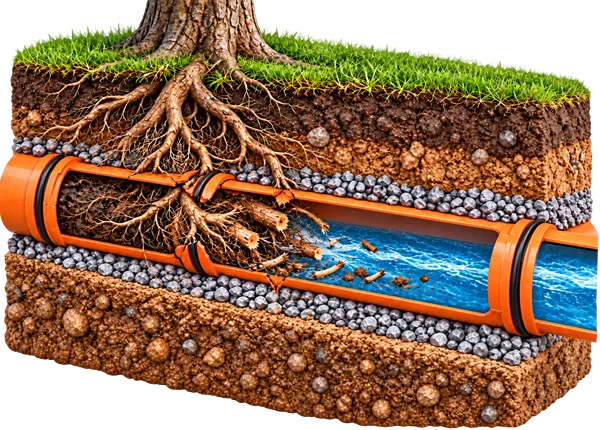
How Tree Roots Damage Drains
Understanding how roots get into a drain in the first place helps explain why tree root removal has to be done properly, rather than just cleared and left. Roots aren't opportunistic in the way a blockage from wipes or fat is. They actively seek out the conditions inside a damaged pipe, and once they've found them, they don't let go easily.
Entry Points
Roots get into a drainage system through cracks, fractured sections, displaced joints and seals that have worn away over time. Older clay pipes with mortar joints are especially vulnerable to this. But roots can just as easily work their way into modern PVCu systems, wherever a rubber ring joint has shifted or perished.
Growth Inside the Pipe
Once a root is inside, fine root fibres spread out along the pipe in both directions. They feed on the moisture and nutrients carried along in the wastewater. What starts as a single thin tendril can grow into a dense mass, capable of filling a standard 110mm pipe within one growing season. A problem that looked minor at first can escalate quickly.
Secondary Damage
As the root mass expands, it pushes outward against the pipe walls from the inside. This widens the crack it originally entered through and forces joints further apart. Left long enough, it can lead to a full fracture or collapse of the pipe. Along the way, the roots also trap waste and debris, which is why the same drain tends to block again and again until the root growth is dealt with.
Seasonal Patterns
Root problems tend to show up most often between late spring and early autumn, when trees are growing most actively and searching hardest for moisture. That said, roots already established inside a pipe will carry on causing blockages all year round. So, we treat root intrusion whenever it happens, not just during the warmer months.
Our Tree Root Removal Methods
Once we know exactly where the roots are and how far they've spread, we choose whichever combination of methods will clear the pipe most effectively and leave it properly protected against regrowth.
Mechanical Root Cutting
For established root growth, we fit powered cutting attachments to our rodding equipment. The spinning head shears the root mass away from the pipe walls and breaks it into pieces small enough to flush away. This is generally the most effective option where roots have filled a significant part of the pipe, and flushing alone wouldn't be enough.
High-Pressure Jetting
For finer root networks, or as a finishing pass after mechanical cutting, we use specialist jetting nozzles. These direct high-pressure water at the root fibres to sever them and flush the debris downstream. Jetting works particularly well on early-stage intrusion, and it's also how we make sure a pipe is genuinely clean once the heavier cutting work is done.
CCTV-Guided Treatment
Every job starts and finishes with a camera survey. The first survey shows us where the roots have entered, how far they've spread, and what condition the pipe is in, so we know which methods to use before we start. Once the root growth has been removed, a second survey confirms the pipe is clear. It also highlights anything that might need repairing or relining to stop the problem coming back.
Preventing Regrowth with Drain Relining
Cutting the roots out solves the immediate problem. But if the crack or joint that let them in stays open, roots will simply find their way back eventually. For lasting protection, we can reline the drain after root removal. The resin liner seals every crack, joint and gap along the length of the pipe, creating a smooth, jointless surface that gives roots nothing to take hold of.
Call or send an enquiry.
Why Choose Plumbco?
Tree Root Removal FAQs
They can, if the entry point they originally used isn't sealed afterwards. Cutting or jetting clears the growth that's already there, but it doesn't close off the crack or joint that let the roots in. That's why we recommend relining wherever the pipe is damaged. It seals the entry point permanently and stops roots getting back inside.
Get In Touch
If you've noticed a recurring blockage, a gurgling drain or slow-draining water near a tree or large shrub, it's worth having it looked at before the problem gets any worse. Our engineers cover Dorset, Hampshire and Wiltshire, and if you need tree root removal, we'll survey the problem, agree a fixed price and get it sorted.
There's no call-out fee and nothing extra for evenings, weekends or bank holidays. Call us on 0808 303 8888 or fill in our contact form to arrange a visit.
-
Engineers on call 24/7
-
A clear price before we start